Build an AI Course for Your Discipline
One practical framework. Many disciplines.
AI Capable Aggies provides a reusable framework for building rigorous, one-unit AI courses across Texas A&M. Each department chooses the professional tasks, tools and examples that matter to its students. The framework supplies a common approach to learning outcomes, responsible AI use and evidence of competency, while leaving disciplinary teaching decisions to faculty.
Framework for faculty adoption
Shared competency, flexible implementation
Every Aggie should be able to apply AI appropriately, check its results against disciplinary evidence, protect sensitive information and explain when human judgment must prevail.
Common across Texas A&M
Every course establishes usable AI literacy, authentic application, evaluation of outputs, responsible-use expectations and demonstrable student competency.
Determined by each department
Faculty select the discipline's problems, tools, datasets, learning activities, evidence standards, specialized risks and appropriate forms of assessment.
Five Steps to a One-Unit AI Course
A lightweight design process that faculty can adapt to nearly any discipline. Each step asks one question, calls for one action, and produces one concrete output.
-
Define
What real task should students do better with AI?
Select one authentic departmental workflow, an intended student cohort and a clear boundary on permitted AI use.
OutputOne-sentence course purpose and target learners.
-
Design
What must students know and demonstrate?
Select three to five measurable learning outcomes. Retain the shared competency expectations below, adapted to the field.
OutputLearning outcomes and a short module outline.
-
Practice
Where will students use AI on a realistic task?
Build guided demonstrations, hands-on exercises and a small applied project using disciplinary data or a safe substitute.
OutputOne authentic learning activity with sample inputs and expected evidence.
-
Safeguard
What could go wrong and how will students respond?
Specify verification, privacy, data ownership, security, bias, provenance and human oversight rules relevant to the field.
OutputOne-page responsible-use protocol and disclosure expectations.
-
Prove & Refine
How will a student show competent, responsible use?
Assess the project, verification evidence and justification of decisions; gather feedback and revise after delivery.
OutputAssessment rubric, student evidence and one improvement note.
The steps are shared. The disciplinary tools, examples, risk controls and assignments are faculty choices.
Every one-unit course enables students to
- ApplyUse an AI capability to support an authentic task within the discipline.
- EvaluateCheck outputs using credible disciplinary methods, sources or tests; identify uncertainty and failure cases.
- Use responsiblyManage confidentiality, privacy, cybersecurity, bias, attribution and appropriate human oversight.
- ExplainDescribe why AI was used, what the student verified and what judgments remained with a human.
These are shared competency categories, not identical assignments or mandated teaching technology.
Each department chooses
- Its course title, intended learners, entry prerequisites and discipline-specific competencies.
- Its own case studies, data, tools and permitted AI systems.
- Lectures, labs, workshops, asynchronous instruction or a combination consistent with university approval requirements.
- Whether evidence is a design artifact, annotated workflow, research protocol, engineering model, case analysis, code project or another authentic deliverable.
No universal coding requirement. Students in non-computing disciplines must be able to demonstrate meaningful AI competency without being required to build software.
Start with the Faculty AI Course Blueprint
Faculty can start with these eight blocks rather than writing a full syllabus from scratch. Copy it, fill it in, and bring it to the conversation.
ONE-UNIT AI COURSE BLUEPRINT

Department / program:
Faculty lead:
Intended learners / prerequisites:
Authentic disciplinary task:

Course purpose (one sentence):

MEASURABLE LEARNING OUTCOMES (3 to 5)
1. Apply AI to ...
2. Verify the result by ...
3. Protect data / disclose use / apply human review by ...
4. Explain the decisions and limitations of ...
5. Optional discipline-specific outcome:

LEARNING ACTIVITIES
Guided demonstration:
Hands-on exercise:
Authentic project or research task:

TOOLS AND DATA
AI tools and any access requirements:
Data sources and restrictions:

RESPONSIBLE USE RULES
Allowed uses:
Sensitive or prohibited inputs:
Validation and disclosure requirements:
Human oversight / escalation:

COMPETENCY EVIDENCE
Student artifact:
Verification record:
Short explanation / reflection:

ASSESSMENT AND ITERATION
Rubric criteria and weights:
Feedback and revision plan:
Use as an adaptable planning tool; course approval, credits, and delivery follow departmental and university policy.
Fifteen contact hours, five blocks
An example, not a universal credit policy. Academic units must validate contact hours, out-of-class work, modality and course approval under their applicable policies. The five blocks may be delivered as a sprint, across multiple weeks or in another approved format.
| Learning block | Illustrative time | Student activity |
|---|---|---|
| 1. Understand | 3 hours | Establish use cases, capabilities, limitations and baseline competency. |
| 2. Apply | 3 hours | Practice the AI workflow on a discipline-specific case. |
| 3. Validate and safeguard | 3 hours | Test outputs, record uncertainty and apply responsible-use rules. |
| 4. Build | 3 hours | Complete a short authentic project or research-oriented task. |
| 5. Demonstrate | 3 hours | Present evidence, justify decisions and reflect on failure modes. |
Assess Competency, Not Just Tool Use
Students submit an actual disciplinary artifact with enough evidence to evaluate their own decisions. The weights below are illustrative and adjustable; every department can define its own field-appropriate evidence and grading scheme.
| Criterion | Example weight | What to look for |
|---|---|---|
| Authentic disciplinary application | 30% | The AI-supported work addresses a meaningful domain task. |
| Verification and critical judgment | 30% | Evidence shows testing, source checking, independent reasoning or uncertainty analysis. |
| Responsible AI practice | 25% | Data handling, disclosures, attribution, safety constraints and human oversight are appropriate. |
| Communication and reflection | 15% | Student explains choices, limitations, corrections and what they would improve. |
These examples are illustrative. They do not state that the named departments have already approved such assignments.
From One Framework to Many Disciplines
The same design process can serve different schools, colleges and departments. These visual examples show how a common framework may be adapted to disciplinary practice, while leaving faculty in control of methods, evidence standards and responsible-use requirements.
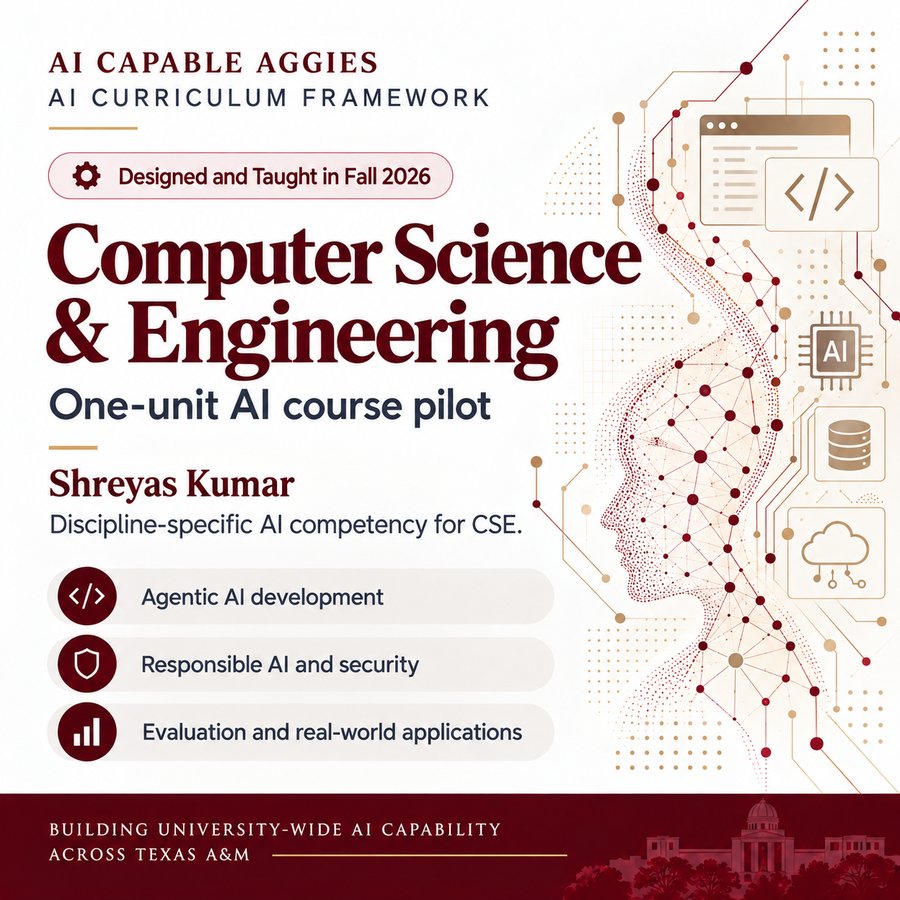
Designed and taught in Fall 2026
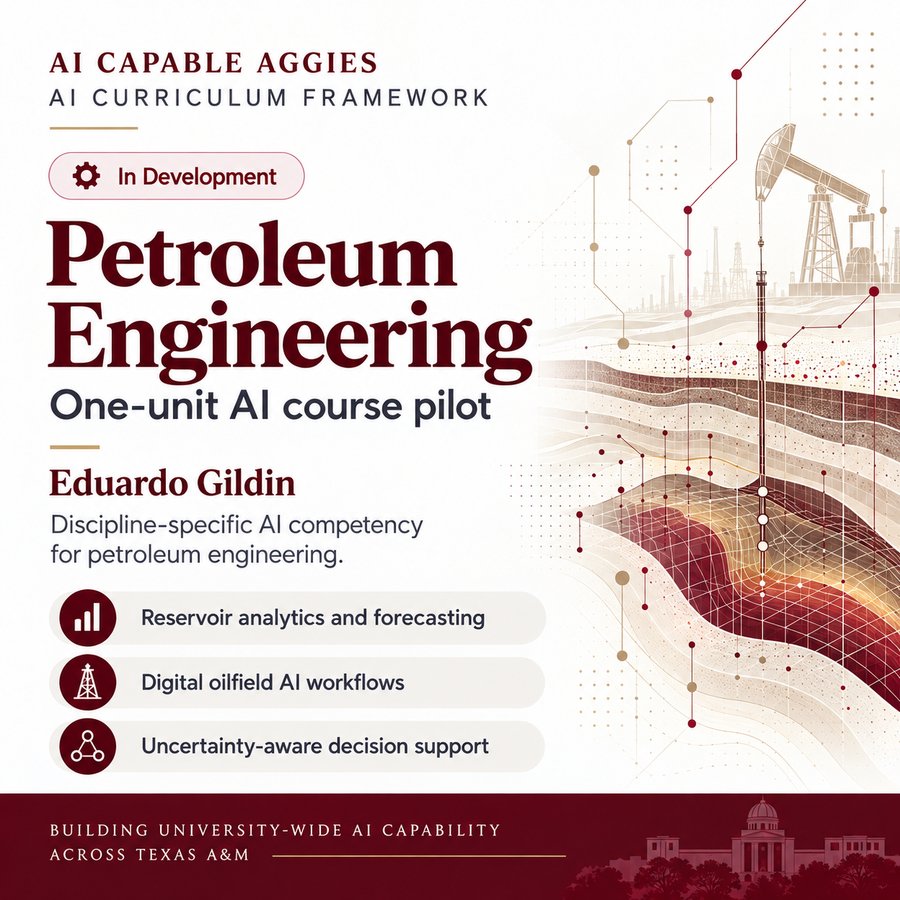
In Development
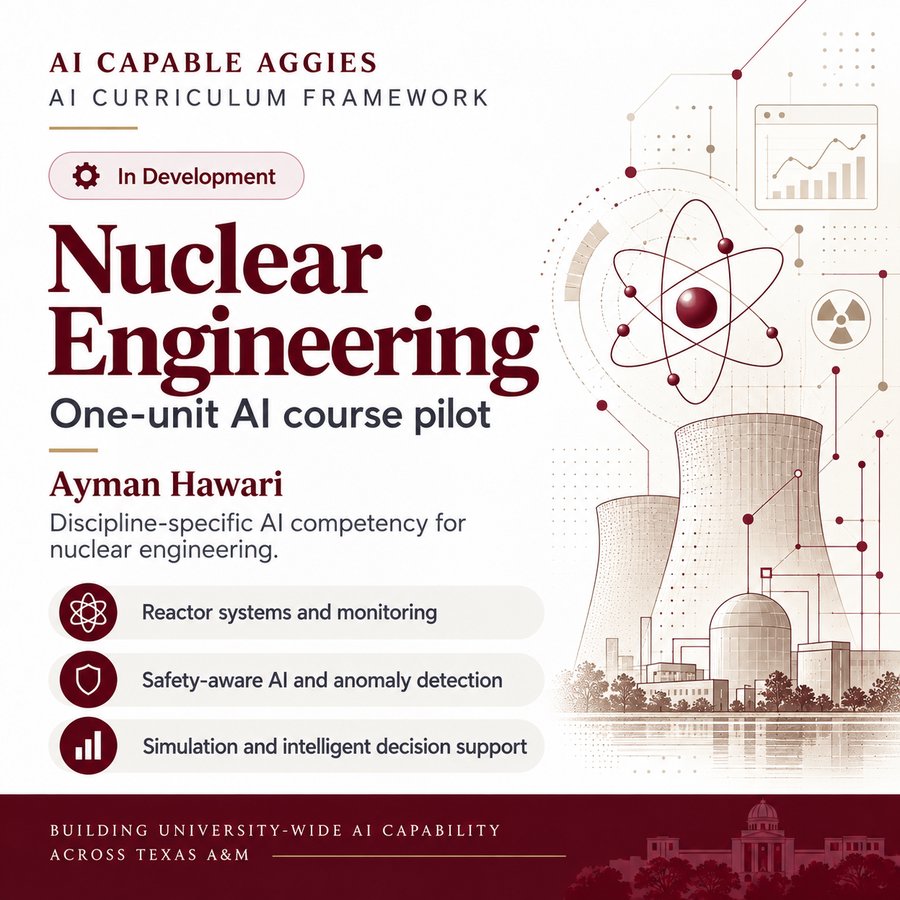
In Development
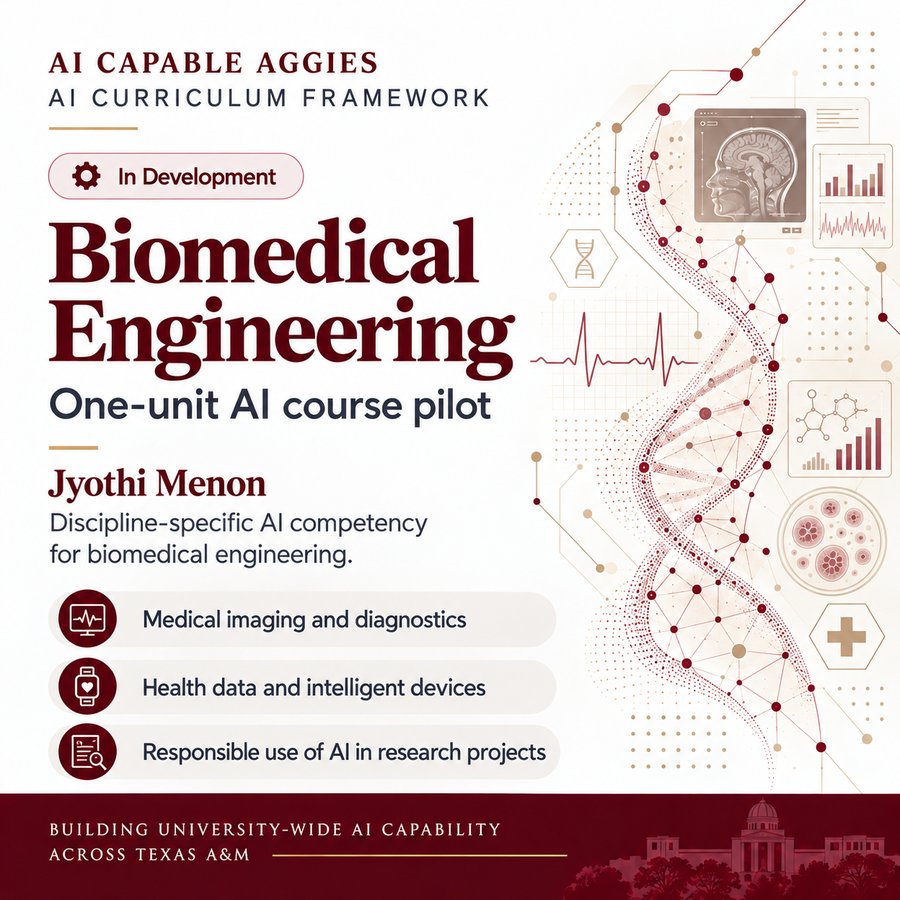
In Development
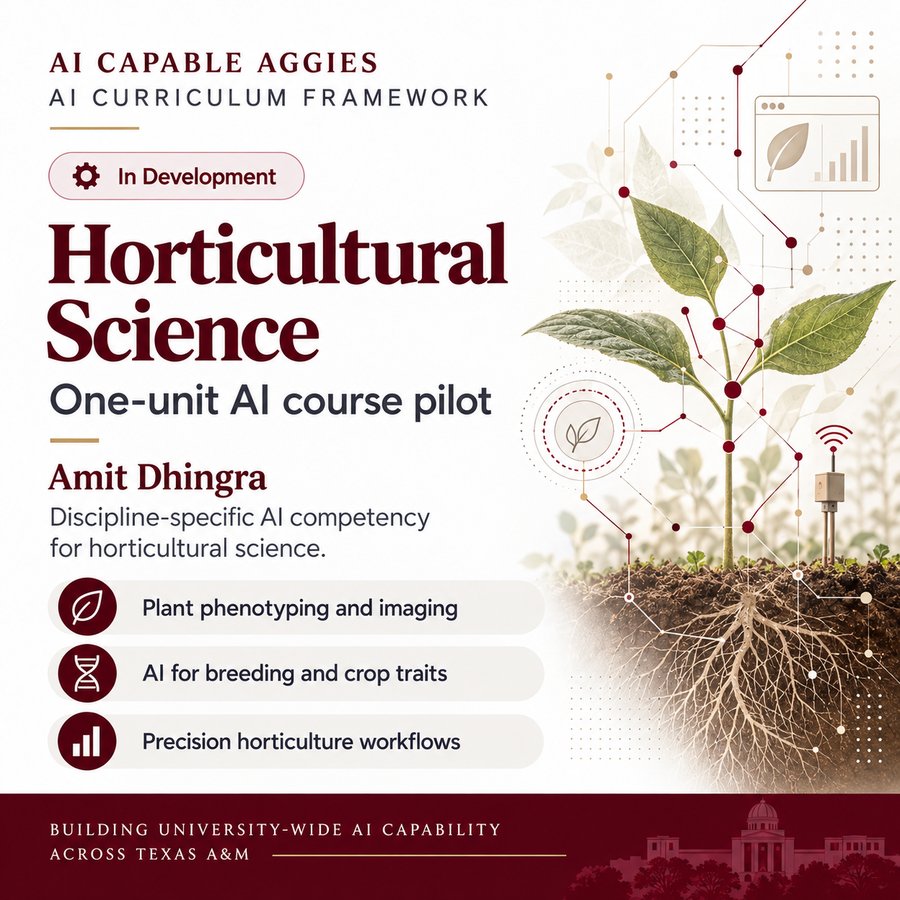
In Development
Open
Pilot status, faculty leads and course details for each department are tracked on the AI Across the Disciplines page (Pillar B). This page explains how departments design a course, not the pilots themselves.
What the framework will add next
The five steps, blueprint and assessment pattern on this page are usable now. The supporting templates and portal resources below are in development and will be linked here as each is published.
Course blueprint template
The blueprint above as a fillable document, with worked examples from the first pilots.
In developmentExample syllabus
A complete one-unit syllabus built with the five steps, showing how the blocks map to weeks or a sprint.
In developmentModule ideas
Short, swappable module outlines for guided examples, hands-on exercises and applied projects.
In developmentAssessment templates
Rubric and evidence templates faculty can adapt to their discipline's deliverables and grading scheme.
In developmentResponsible AI guidance
Verification, privacy, security, bias, attribution and human-oversight guidance to adapt into each course's protocol.
In developmentCurriculum portal
A place to find, submit and share course materials across departments.
In developmentBring this framework to your department
Share a proposed use case: the real task your students should do better with AI, who the students are, and what evidence of competency would look like in your field. That is enough to start.
What to send
- Department and intended students
- One real task or professional workflow
- Tools or data you expect to use, if known
- Anything that must stay private or be de-identified
Explore the other pillars
Help Build an AI Capable Texas A&M
Faculty, students, academic leaders, and university units are invited to contribute course ideas, discipline-specific use cases, teaching resources, and challenge problems.