AI Capable Aggies Microcredential Roadmap
A proposed series of stackable AI microcredentials that combines a common foundation in responsible AI with progressively advanced capabilities in agentic development and discipline specific applications.
Planning roadmapCredential titles and pathways are proposed; approval, requirements, assessment criteria, and availability will be published when confirmed.We are very thankful to Mr. Adrian Alba, Office of Academic Effectiveness and Planning at the Provost Office, for his kind guidance.
Three Levels of AI Competency
Every credential in the roadmap sits at one of three levels. The descriptions explain the intent of each level; they are not approved competency standards, assessment rubrics, or certificate requirements.
General Agentic AI Pathway
The general pathway begins with responsible AI practice, advances through agentic AI development, and culminates in advanced agentic AI development.
All badges and credentials on this page are for illustration purposes only, subject to approvals by University authorities. Names and design of badges and microcredentials may vary.
Discipline Specific Proficiency Pathways
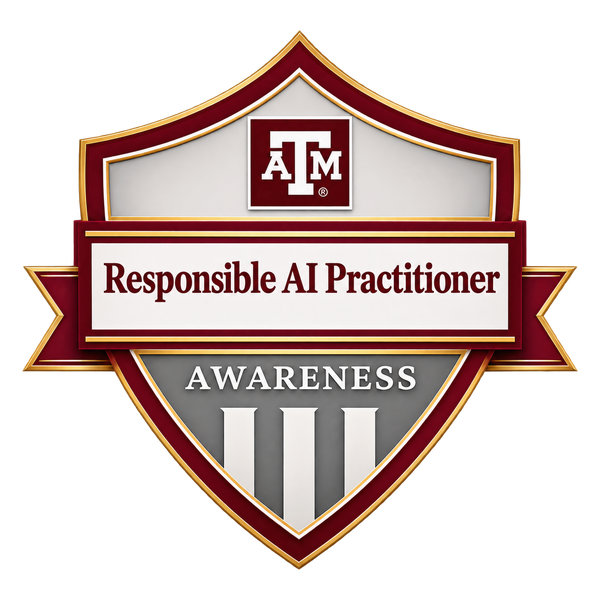
Every disciplinary pathway builds on the common Responsible AI Practitioner Awareness credential. Each pathway currently has a planned Proficiency credential; its Mastery credential is still to be determined.
Awareness Responsible AI Practitioner is the shared foundation for all five disciplinary pathways below.
All badges and credentials on this page are for illustration purposes only, subject to approvals by University authorities. Names and design of badges and microcredentials may vary.
Agentic AI Development
A five-day course taught by Dr. Shreyas Kumar. Students operate an agentic rig end to end, build a research agent, compose multi-agent workflows, and prepare for the Claude Certified Developer – Foundations certification.
Learning objectives
Upon successful completion of the course, students will be able to:
- Operate an agentic rig — command-line/IDE, shell, version control, and API access — to drive an agent through a reproducible task.
- Design prompts and engineer context (instruction files, retrieval, automated context management) that measurably improve an agent’s performance.
- Implement a research agent with tool definitions, a control loop, and structured outputs that completes a research task end to end.
- Compose reliable multi-step and multi-agent workflows with verification, retries, memory, and logging, and report failures honestly.
- Scope, build, evolve, and critically analyze a discovery system for a problem in the student’s own research domain.
- Use AI critically and transparently: judge when to trust an agent’s output, verify its claims against ground truth, disclose AI’s role in the work, and recognize and name failure modes.
- Prepare for the Claude Certification: Claude Certified Developer – Foundations.
Coverage, day by day
- Day OneIntroduction and setup · How Claude Code works, model selection and optimization (full environment setup required before the second session)
- Day TwoYour first project / MVP — how to tell Claude exactly what to build · Context, sessions,
.mdfiles, and agents - Day ThreeCybersecurity, ethics, privacy, cost control · Dealing with common problems
- Day FourPrompt and context engineering · Applications and integration — requirements, lifecycle, failure handling, configuration, and design
- Day FiveEvaluation, deployment, debugging, and automated testing · Final mock exam: Claude Certified Developer – Foundations
A pilot course in the area of the General Agentic AI Pathway above. Completing it does not by itself confer a roadmap credential. The certification named here is offered by Anthropic, not Texas A&M; the course prepares students for it.
Planned Credentials and Next Steps
This roadmap defines proposed credential names and progression levels. Program details, assessment requirements, academic approvals, and launch schedules remain subject to development and confirmation.
Faculty, students, academic leaders, and university units are invited to help shape the credentials: propose discipline specific competencies, teaching resources, and assessment ideas.
Explore the other pillars
Help Build an AI Capable Texas A&M
Faculty, students, academic leaders, and university units are invited to contribute course ideas, discipline-specific use cases, teaching resources, and challenge problems.